Have you ever experienced itchy, irritated ear canals from hearing‑aid wear, or early device failure caused by corroded metal contacts? Many hearing‑aid users of rechargeable hearing aids face these annoying issues, mostly stemming from corroded metal contacts exposed to ear moisture and sweat. To better address these real‑world pain points, let’s look at the two sorts of primary rechargeable hearing aids today.
Contact Charging vs Contactless Charging
- Contact Charging: Power flows through physical touch between exposed metal contacts on the hearing aid and its charging case. This is the dominant solution for most modern rechargeable hearing aids. While it delivers direct, efficient power transfer, metal contacts suffer from wear, oxidation and corrosion. These problems can trigger ear‑canal irritation and lead to charging failure due to dirt and contact degradation.
- Contactless Charging: Energy transfers via electromagnetic fields with no physical metal‑to‑metal contact. The hearing‑aid shell can be fully sealed to avoid wear‑and‑corrosion risks. Nevertheless, it raises strict requirements for product design, especially for discreet hearing aids with ultra‑compact form factors.
|
|
Contact Charging
|
Contactless Charging
|
|
Power Transfer
|
Physical metal contacts
|
Electromagnetic field, no physical contact
|
|
Seal integrity
|
Exposed contact point prevents full sealing
|
Fully sealed for better waterproof performance
|
|
Wear and Tear
|
Severe
|
No wear and tear
|
|
Technical Difficulty
|
★★
|
★★★★★
|
|
Potential Skin Risk
|
Ear‑canal irritation or allergies
|
No exposed metal contacts, zero irritation
|
Yeasound Contactless Charging Innovation
Yeasound has long upheld its core mission: Empowering everyone to hear the world without limits. Guided by this enduring commitment, we leverage cutting‑edge innovation to dismantle long‑standing tech barriers and deliver renewed hearing experiences for end users seeking reliable rechargeable hearing aids.
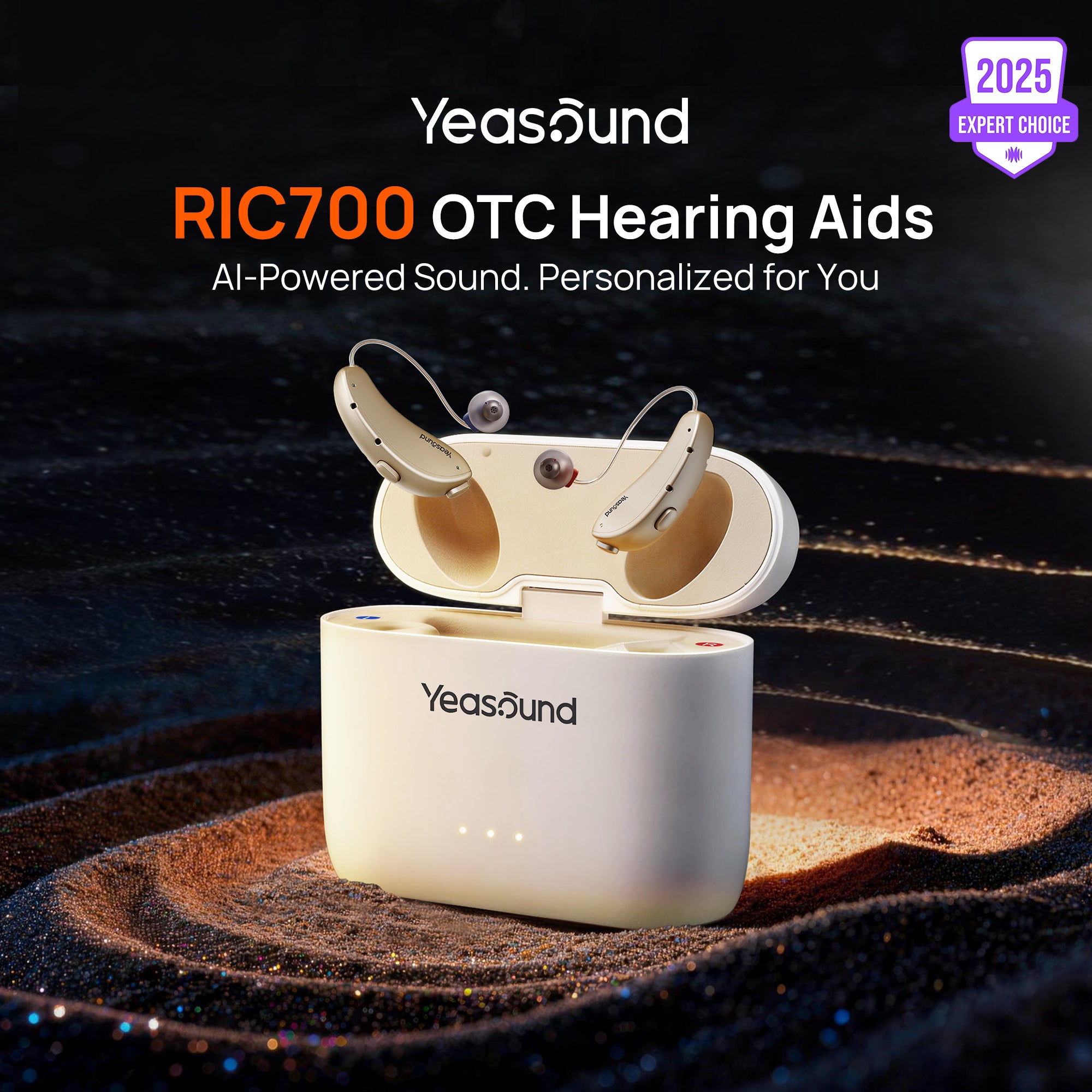
Drawing upon 8 years of accumulated contactless charging R&D expertise inherited from parent company Yealink, Yeasound has invested 5 years in developing a charging ecosystem dedicated to hearing‑aid hardware. This proprietary technology has been integrated across our complete product portfolio, encompassing the Robin CIC60, RIC800 and RIC700, rendering Yeasound the sole OTC hearing‑aid manufacturer to have accomplished this meaningful technical milestone.
Charging‑Efficiency Breakthrough : Solving Energy‑Loss Challenges in Miniature Form Factors
Contactless charging relies on energy transfer via electromagnetic fields, inherently incuring substantial power dissipation and suppressing overall efficiency to merely 10‑15% of what contact charging can achieve — a bottleneck that has plagued the industry for years, particularly for tiny discreet hearing aids.
Yeasound engineering team adopted self‑developed magnetic‑shielding technology alongside iteratively refined coil geometries derived from exhaustive simulation workflows. Thousands of simulation cycles and prototype calibrations were conducted to minimize losses across the power‑transfer pathway. The final result delivers 2 hours of usage from a 15‑minute fast‑charge cycle, while a full charge finishes within 3.5 hours. Its charging performance competes with many of the best rechargeable hearing aids on the market priced above $3000, while maintaining an ultra‑compact, discreet hearing aids form factor. This innovation overturns the common industry assumption that contactless charging must equal poor efficiency.
|
Items
|
Yeasound CIC60
|
Brand A
|
Brand B
|
Brand D
|
Brand E
|
|
Price
|
$399
|
$999
|
$2500
|
$4000
|
$2699
|
|
Category
|
OTC & Prescription
|
OTC
|
Prescription
|
Prescription
|
OTC
|
|
Style
|
CIC
|
CIC
|
CIC
|
ITE
|
CIC
|
|
Weight
|
1.3g
|
1.5g
|
1.5g
|
--
|
0.95g
|
|
Charging
|
✓ Contactless
|
✓ Contact
|
✓ Contact
|
✓ Contact
|
✓ Contact
|
|
Fast Charging
|
15mins for 2hrs
|
15mins for 3hrs
|
15mins for 3hrs
|
1mins for 4 hrs
|
15mins for 3hrs
|
|
Charging Time
|
3.5 hours
|
3.5 hours
|
3.5 hours
|
2 hourss
|
3-4 hours
|
Mass‑Production Consistency : Bringing Lab‑Grade Performance to Every Unit
Conventional hearing‑aid matching circuits generally operate with approximately 20% tolerance, whereby minor component‑level deviations acan trigge unstable charging signal transmission or inaccurate battery‑level reporting.
To resolve this challenge, Yeasound has driven improvements across both component sourcing and iterative circuit calibration workflows. Rather than deploying low‑cost components, we select high‑grade critical parts shared with $3000+ prescription‑grade hearing aids, which exhibit superior resistance to temperature drift, enhanced stability and heightened immunity against electromagnetic interference.
Our R&D team constructed large‑scale prototype batches and simulated a broad spectrum of temperature‑humidity environmental profiles to execute thousands of iterative circuit‑tuning cycles, during which signal coupling, frequency alignment and noise rejection were rigorously validated.
Combined with multiple proprietary technical implementations, we elevated matching‑circuit precision to 2%. This refined system accommodates the narrow design tolerances intrinsic to discreet hearing aids, compensating for component variance, assembly discrepancies and external environmental disturbances to guarantee that end users receive performance equivalent to results observed within controlled laboratory environments.
Rigorous Reliability‑Testing Framework
Yeasound holds ISO 13485 quality‑system certifications. Every product undergoes validation through a reliability‑testing framework consisting of 4 major categories and 30 sub‑items, benchmarked against premium prescription‑grade rechargeable hearing aids to deliver longer‑lasting and more comfortable wearing experiences for users.
- Battery Endurance : Every batch of products completes 1500 charge‑discharge cycle tests. Upon test completion, Yeasound devices retain 92 % of their original battery capacity — significantly exceeding the industry’s general threshold of 80 %.
- Temperature Adaptability : Multi‑scenario environmental validation confirms consistent charging and operation across the 32‑104 °F temperature range, which covers the vast majority of everyday living conditions.
- Water‑Resistance Performance: thanks to enhanced sealing, Yeasound products remain fully operational following 2 weeks of submersion test, much longer than IPX8 standard (1hr). Such performance holds up reliably against rains, sweat and many other real‑life daily scenarios.
Conclusion
Many dissatisfying using experiences with hearing aids stem from subtle yet consequential design oversights, all of which disrupt day‑to‑day conversation and routine activity. Anchored by our long‑held mission, every technical advancement engineered by Yeasound originates from observable real‑world user scenarios. Instead of expecting consumers to adapt to hardware limitations, our team builds technology that adapts to human anatomy and varied everyday environments to deliver robust hearing aids built for long‑term daily deployment.
FAQ
What is contactless charging for hearing aids?
Hearing‑aid wireless charging transfers power via electromagnetic fields without physical metal‑contact connection, as the charging case replenishes energy with no direct contact to exposed hardware surfaces, which in turn facilitates superior housing sealing.
What main advantages does contactless charging have over contact‑based charging?
1 The elimination of exposed metallic contacts removes wear‑related degradation and sweat‑driven corrosion, eliminating ear‑canal skin irritation. 2 A fully sealed enclosure unlocks enhanced waterproof performance. 3 Users are spared charging‑system malfunctions caused by aged or oxidized physical contacts.
Why are so few in‑the‑canal hearing aids equipped with contact‑free contactless charging?
The core barrier comes from ultra‑tight internal space. contactless charging for CIC hearing aids brings overlapping challenges such as insufficient charging efficiency, unstable communication and poor mass‑production consistency. It demands heavy dedicated R&D investment.
How is Yeasound CIC60 contactless‑charging different from competitors?
Most miniature hearing aids on the market still rely on contact charging. Yeasound Robin CIC60 integrates a complete contactless‑charging system inside its tiny CIC shell. Hardware‑software co‑design addresses efficiency, thermal management, communication and mass‑production consistency. It achieves long battery life and superior waterproof performance, structurally eliminating contact‑corrosion‑related troubles.







Share:
Stay Updated
Get the latest hearing tips & news delivered to your inbox.