




Your partner mentioned - again - that the TV is too loud. You asked a coworker to repeat themselves twice in the same meeting and smiled through the third time rather than ask again. At a dinner party last weekend, you nodded along to a story you only half heard. If these moments sound familiar, a quick free online hearing test can be a low-pressure way to check whether the pattern is worth tracking.

None of these moments feel dramatic. But they've been happening more often. And at some point, the question shifts from "is something off?" to "is this actually something I should deal with?" For people noticing these early patterns, OTC hearing aids may become relevant only after the symptoms look gradual, consistent, and mild-to-moderate.
The honest answer depends on what you're experiencing, how often, and whether it's affecting how you live. Here's how to tell the difference.
The Symptoms People Usually Dismiss First
The earliest signs of hearing loss are easy to rationalize. They show up in specific situations - noisy places, phone calls, voices from across the room - and disappear in others. That selective pattern is actually a clue.
Struggling to follow conversations in background noise is usually the first thing people notice. A restaurant, an open-plan office, a family gathering - situations where multiple sounds compete. You hear fine one-on-one in a quiet room, but lose the thread as soon as the environment gets busier. This is not a focus problem. It is a processing problem. For a deeper look at why speech gets harder in busy places, see why SNR matters for clear conversations.
Asking people to repeat themselves - particularly for specific words rather than whole sentences - suggests high-frequency sensitivity loss. The consonants S, F, SH, TH carry much of speech intelligibility. When you can hear the rhythm of a sentence but miss the words, high-frequency loss is often the reason.
Turning the TV or phone volume higher than others prefer is one of the clearest behavioral signals. It is not a preference. It is compensation.
Phone calls feeling harder than in-person conversation makes sense neurologically: without lip reading and visual cues, you're relying entirely on the audio signal. Even a mild high-frequency loss becomes more noticeable without that visual backup.
If any of these show up occasionally, that's not necessarily cause for concern. If they're consistent - present in most interactions in challenging environments - that's worth paying attention to.
Symptoms That Are More Urgent

Some hearing changes are not gradual. These deserve a faster response.
Sudden hearing loss in one or both ears - particularly if it came on overnight or over a few hours - is a medical emergency. Sudden sensorineural hearing loss (SSHL) affects roughly 1 in 5,000 adults per year, often with no obvious cause. Treatment with corticosteroids is most effective within the first 72 hours. This is not an OTC hearing aid situation - it requires same-day medical attention.
Hearing loss accompanied by dizziness, ear pain, or drainage points toward a structural or infectious cause - inner ear infection, Meniere's disease, or perforated eardrum - that needs a doctor's evaluation before any other intervention. If you want a practical checklist for when hearing decline is not normal, this related guide can help: When Is Hearing Decline Not Normal?
Ringing, buzzing, or hissing in the ears (tinnitus) alongside hearing difficulty can indicate inner ear damage. Tinnitus alone is common and often benign, but tinnitus paired with noticeable hearing changes warrants an audiologist visit.
Asymmetric hearing loss - one ear significantly worse than the other, or one ear that recently changed - is less typical of age-related loss, which usually affects both ears similarly. One-sided changes should be evaluated.
What Normal Aging Actually Sounds Like
Age-related hearing loss - presbycusis - is gradual, bilateral (both ears), and starts in the high frequencies. According to the National Institute on Deafness and Other Communication Disorders (NIDCD), approximately one in three adults between 65 and 74 has some degree of hearing loss, and nearly half of those over 75.
The typical progression:
· First: difficulty with high-pitched consonants (S, F, TH) in noise
· Later: speech in any noisy environment becomes effortful
· Eventually: some difficulty even in quieter settings
What distinguishes this from hearing that just needs a moment to adapt: the pattern is consistent. It doesn't come and go with mood or attention. It shows up the same way in the same types of situations, week after week.
One thing worth knowing: the average person waits 5-7 years after first noticing these changes before addressing them. That's partly denial, partly the slowness of the progression. But it also means people spend years modifying behavior to compensate - turning down social invitations, watching TV alone, nodding through conversations - before the problem is acknowledged.
| Symptom | Likely signal | Suggested next step |
|---|---|---|
| Occasional mishearing in noise | Early / not yet significant | Monitor; track frequency |
| TV regularly louder than others prefer | Mild hearing loss likely | Consider online screener or OTC trial |
| Frequently asking for repeats in conversation | Mild-to-moderate loss possible | Hearing screener or audiologist check |
| Difficulty in quiet settings too | Moderate loss | Audiologist evaluation recommended |
| Sudden change, one-sided, with pain | Urgent - possible medical cause | See a doctor within 24-72 hours |
"But Is It Bad Enough to Do Something About?"
This is the question most people are actually asking. Not "do I have hearing loss?" but "does it warrant action yet?"
A few honest markers:
It's affecting how you connect with people. Missing the punchline. Misreading a situation because you caught the wrong word. Exhaustion after social events from the effort of listening. These aren't just inconveniences. They quietly erode quality of life over time.
You're changing your behavior to avoid hard listening situations. Choosing quieter restaurants. Sitting out conversations at gatherings. These workarounds feel like small adjustments, but they represent real lost ground.
Other people have noticed. A partner, family member, or colleague who's mentioned it more than once isn't exaggerating.
If any of those are true, "not bad enough yet" is probably the wrong frame. The question becomes: what's the lowest-friction way to find out how much is actually going on? A simple screener can be a low-pressure first step before you decide whether to compare devices or book a clinical evaluation.
What to Do If Your Symptoms Fit the Gradual Pattern

For adults experiencing the gradual, bilateral, noise-specific pattern typical of age-related sensorineural hearing loss, a few practical options exist:
Free online screeners - services like HHIE-S self-assessments or quick hearing checks provide a starting point, not a diagnosis. Use them to notice patterns, then follow up with a clinician if symptoms are sudden, one-sided, painful, or changing quickly.
Audiologist pure-tone audiogram - the clinical gold standard, usually covered by insurance or available at low cost. Takes about 30 minutes. Tells you the type, degree, and frequency pattern of your loss.
OTC hearing aids with a trial period - FDA-registered OTC devices are authorized specifically for mild-to-moderate sensorineural hearing loss in adults. If your symptoms fit the gradual pattern described above, a trial can show whether amplification and speech-focused settings help in the places where you struggle most. For context on how self-fitting OTC devices are designed for speech clarity, noise handling, and everyday listening, see Yeasound's OTC hearing aid sound technology page.
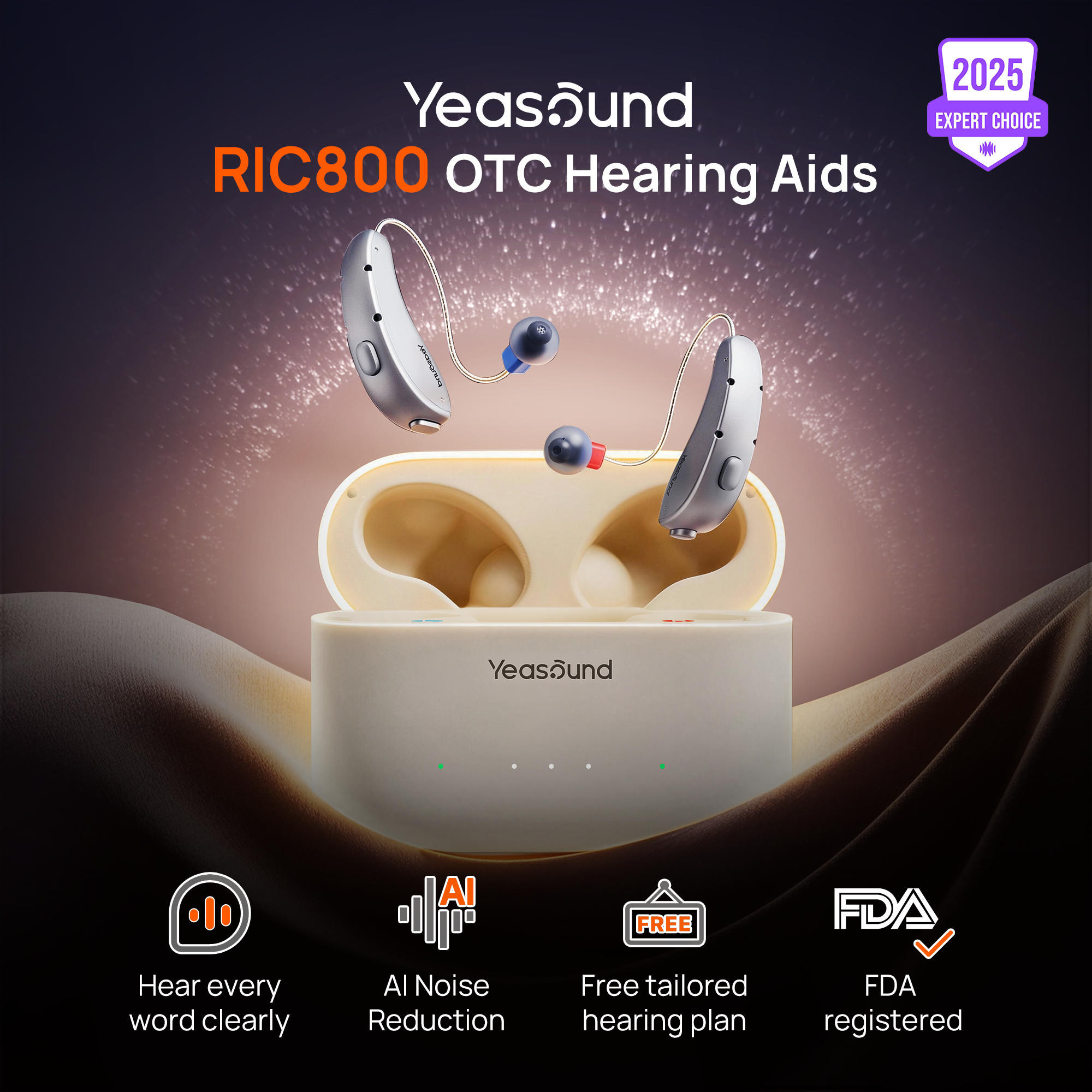
If you decide to compare an actual device, the Yeasound RIC800 is one option that fits this gradual, mild-to-moderate use case more naturally than a generic amplifier. It uses a discreet rechargeable RIC design with AI-driven noise reduction, app-based adjustment, and Bluetooth support for calls and streaming. The 100-day return window and free 1-on-1 remote session with a professional audiologist also give you room to test it in real situations - TV, meetings, restaurants, and family conversations - before deciding whether it belongs in your daily routine. For setup details, the RIC800 guide is a helpful follow-up resource.
The point isn't to rush a decision. It's to stop treating a manageable situation as something to tolerate indefinitely.
FAQ
What are the first signs of hearing loss in adults?
The earliest signs are typically difficulty following conversations in noisy environments, frequently asking people to repeat specific words, and needing higher TV or phone volume than others in the same space. These appear in challenging listening situations before showing up in quiet settings.
Can hearing loss symptoms come and go?
Gradual sensorineural hearing loss, the most common type in adults, is consistent rather than sharply fluctuating. If your hearing seems to vary significantly from day to day or hour to hour, that warrants a medical evaluation. Sudden or fluctuating hearing changes are more urgent than gradual ones.
How do I know if my hearing is bad enough to need a hearing aid?
If your symptoms are consistently affecting conversations, causing you to modify social behavior, or being noticed by people around you, that is a reasonable threshold to take the next step. You can start with a hearing screener, an audiologist check, or compare OTC options if your symptoms fit the mild-to-moderate gradual pattern.
Is it normal to hear fine in quiet but struggle in noise?
Yes, and it is actually the defining pattern of early age-related sensorineural hearing loss. The cochlea loses sensitivity to high frequencies first, which matters much more in noise than in quiet. It is not a focus or attention issue.
What's the difference between hearing loss symptoms and age-related changes?
Normal aging may involve subtle high-frequency sensitivity changes that do not significantly affect daily communication. Hearing loss means those changes are consistent enough to affect how you follow conversations, understand speech, and engage with the people around you.



Share:
Stay Updated
Get the latest hearing tips & news delivered to your inbox.