




If you’ve ever struggled to follow a conversation in a noisy restaurant or busy street, you’ve experienced the impact of Signal-to-Noise Ratio (SNR)—whether you realized it or not.
For people with hearing loss, SNR is often the single biggest factor affecting how well they can understand speech. Let’s break down what it means, why it matters, and how hearing aids are designed to improve it.

What is Signal-to-Noise Ratio (SNR)?
Signal-to-Noise Ratio (SNR) refers to the relationship between:
The signal: the sound you want to hear (usually speech)
The noise: background sounds you don’t want (traffic, chatter, music)
It is measured in decibels (dB) and calculated as:SNR = Speech level – Noise level
Simple examples:
Speech at 65 dB, noise at 55 dB → +10 dB SNR (easy to understand)
Speech at 65 dB, noise at 70 dB → –5 dB SNR (very difficult)
The higher the SNR, the clearer the speech.
Why Does SNR Affect Conversations So Much?
1. Speech clarity depends on contrast—not just volume
Understanding speech isn’t just about making sounds louder. It’s about distinguishing speech from competing sounds. When noise overlaps with speech, especially high-frequency consonants like “s,” “f,” and “t,” clarity drops significantly.
2. Background noise masks important speech cues
Noise can “cover up” parts of speech, making words incomplete or distorted. Even if speech is technically audible, it may not be understandable.
3. Hearing loss increases SNR requirements
People with normal hearing can often understand speech even when speech and noise are at the same level (around 0 dB SNR).
However, people with hearing loss typically need:
+5 to +15 dB SNR for similar understanding
This means they need speech to be significantly louder than background noise to follow conversations.
4. Amplification alone is not enough
Turning up the volume increases both speech and noise. This does not improve SNR—and can sometimes make listening more uncomfortable due to loudness sensitivity.
How Yeasound Hearing Aids Help Improve SNR
Yeasound hearing aids are designed not just to amplify sound, but to improve the balance between speech and noise.
Directional microphones
With Yeasound, hearing aids microphones work together to focus on sounds coming from in front of the user—where speech usually comes from—while reducing sounds from other directions.
Benefit: Improves SNR by prioritizing speech over background noise.
Intelligent environment detection (AI)
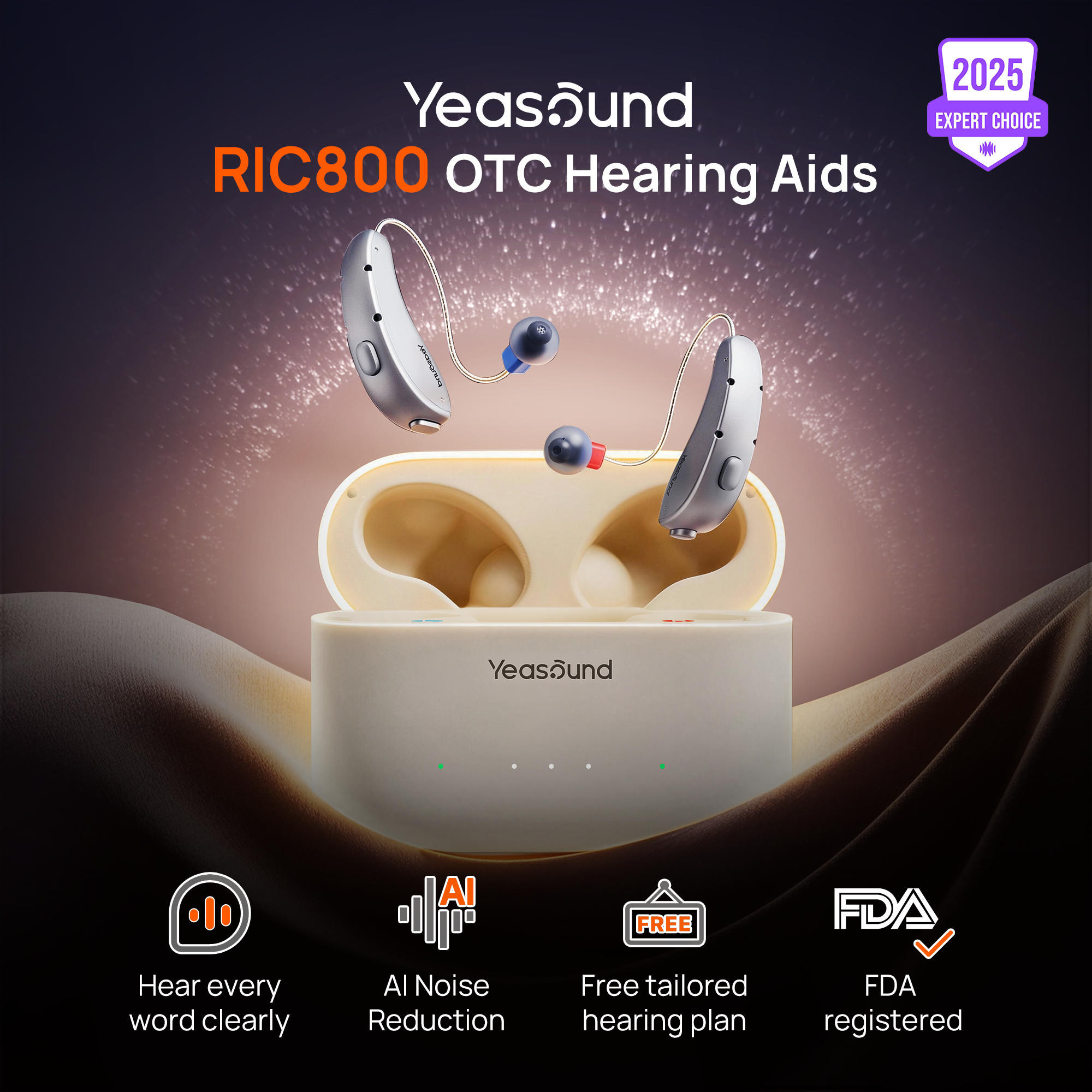
Yeasound RIC800 can automatically analyze the listening environment and adjust settings in real time—switching between quiet, noisy, or music modes.
Benefit: Optimizes SNR without manual adjustments.
AI Noise reduction
Yeasound RIC800's advanced AI algorithms identify and suppress unwanted background noise—such as traffic, wind, or crowd chatter—while preserving speech signals. Unlike traditional noise reduction, AI can adapt dynamically to complex and changing environments.
Benefit: Reduces listening effort and enhances speech clarity, especially in challenging noise conditions.
Frequency shaping and compression
Yeasound hearing aids enhance important speech frequencies and compress loud sounds to keep them comfortable.
Benefit: Improves access to speech details without overwhelming the listener.
Final Thoughts
When it comes to understanding conversations, especially in noisy environments:
SNR matters more than volume
Hearing loss increases the need for better SNR
Yeasound hearing aids are designed to enhance speech and reduce noise, not just make everything louder
Improving SNR means clearer conversations, less listening effort, and a more natural hearing experience—helping people stay connected to the world around them.




Share:
Stay Updated
Get the latest hearing tips & news delivered to your inbox.