




You've been asking people to repeat themselves more often. Conversations at dinner feel like work. You've started reading lips more than you used to. It's easy to brush off, but at some point, the pattern is hard to ignore.

Before you can figure out what to do about it, it helps to understand what type of hearing loss you might be dealing with. If you are wondering how many types of hearing loss are there, the practical answer is that most discussions focus on three main types: sensorineural, conductive and mixed hearing loss. Auditory processing disorder is often discussed alongside them because it can affect listening even when hearing sensitivity looks normal.
This matters because the type largely determines your options. The path forward for someone with conductive hearing loss looks very different from the path forward for someone with age-related sensorineural loss. Knowing that difference can save you time, money, and a lot of second-guessing.
What are the three main types of hearing loss?

Most people have heard terms like "sensorineural" or "conductive" hearing loss without knowing what they mean in practice. Here's a plain-language breakdown of the main types of hearing loss and what each one tends to mean for treatment.
Sensorineural Hearing Loss
Sensorineural hearing loss is by far the most common type in adults. It results from damage to the hair cells inside the cochlea (inner ear) or the auditory nerve that carries sound signals to the brain. These hair cells don't regenerate. Once they're gone, they're gone. The most frequent causes are aging (called presbycusis) and cumulative noise exposure over time.
What this means for you: sensorineural hearing loss is permanent, but it's also the type that responds best to hearing aids. In 2022, the FDA authorized over-the-counter (OTC) hearing aids specifically for adults 18 and older with mild-to-moderate sensorineural hearing loss, no prescription or clinic visit required. If this sounds like your situation, you may want to compare models in the Yeasound RIC Series, which focuses on rechargeable RIC hearing aids for daily speech clarity.
Conductive Hearing Loss
Conductive hearing loss happens when sound can't move efficiently through the outer or middle ear. Common causes include earwax buildup, fluid behind the eardrum (common after ear infections), a perforated eardrum, or abnormal bone growth in the middle ear. Unlike sensorineural loss, conductive hearing loss is often temporary and treatable, sometimes just by removing the blockage.
What this means for you: if you're dealing with muffled hearing that came on recently, especially after a cold, ear pain, or a feeling of fullness in the ear, the first call should be to a doctor, not a hearing aid store.
Mixed Hearing Loss
Mixed hearing loss is a combination of both sensorineural and conductive components. One ear (or both) has damage in multiple locations along the hearing pathway. It's more complex to address and usually benefits from professional evaluation.
Types of Hearing Loss Requiring Medical Attention
Single-Sided Deafness (SSD)
Single-sided deafness means significant hearing loss in one ear while the other functions normally or near-normally. OTC hearing aids are not well-suited for SSD. Specialized devices like CROS hearing aids or bone-anchored systems are typically recommended.
Auditory Processing Disorder (APD)
Auditory processing disorder is different from structural hearing loss altogether. People with APD can detect sounds normally but have difficulty making sense of what they hear, particularly speech in noise. Amplification alone doesn't help. This is a neurological processing issue that requires specialized intervention.
Hearing Loss with Accompanying Symptoms: Promptly see a doctor if hearing loss is paired with:
l Vertigo or dizziness (e.g., Meniere’s disease).
l Pain, draining, or infections in the ear.
l Tinnitus (loud ringing).
l Head injury or physical trauma.
l Facial weakness or numbness.
The most common type you're probably dealing with
If you're asking what is the most common type of hearing loss, the answer for adults is sensorineural hearing loss, especially age-related sensorineural hearing loss. If you're an adult over 45 who has gradually noticed more difficulty in noisy places, finds high-pitched voices harder to follow, and keeps the TV louder than your family prefers, there's a good chance this is the pattern you're noticing.
Presbycusis (age-related sensorineural hearing loss) typically starts with high-frequency sensitivity. Consonants like S, F, TH, and SH become harder to distinguish. That's why words start sounding similar ("fifty" vs. "sixty"), and why people seem to mumble even when they're speaking clearly. For a closer look at how modern devices support speech clarity and noise handling, see Yeasound's OTC hearing aid sound technology page.
The gradual onset is part of why people wait so long to address it. According to the National Institute on Deafness and Other Communication Disorders (NIDCD), the average adult waits 5-7 years after first noticing changes before seeking help. That's a long time to miss parts of conversations.
How severity cuts across all types
Understanding the type of hearing loss is only part of the picture. The degree matters just as much for deciding what to do next.
| Degree | What you typically notice | Common next step |
|---|---|---|
| Mild (20-40 dB loss) | Miss whispers, soft speech, some consonants | OTC hearing aid may be a fit |
| Moderate (41-60 dB loss) | Struggle with normal conversation, need louder TV | OTC or professional evaluation |
| Severe (61-80 dB loss) | Miss most speech without amplification | Audiologist recommended |
| Profound (81+ dB loss) | Hear very little or nothing without strong aids | Audiologist or cochlear implant specialist |
OTC hearing aids, including FDA-registered devices, are designed specifically for the mild-to-moderate range. That's not a compromise. It's a regulatory designation based on what self-fitting can effectively address without professional calibration. If app-based adjustment matters to you, the iYeasound app page explains how volume, presets, speech enhancement, and reminders fit into daily use.
If your loss is in the moderate-to-severe range, or if your symptoms are unusual (sudden onset, one-sided, accompanied by pain or dizziness), professional evaluation is the right starting point.
What conductive loss means before you buy anything
It's worth pausing on this: a surprisingly common mistake is buying hearing aids for what turns out to be conductive hearing loss, often from impacted earwax.

Earwax buildup accounts for a meaningful portion of reported hearing difficulty, particularly in adults over 50. A simple cleaning by a doctor or audiologist can restore hearing that felt like "loss" entirely. According to the American Academy of Otolaryngology, bilateral impacted earwax can cause 20-30 dB of apparent hearing loss, enough to show up on informal self-tests. If you already wear hearing aids, hearing aid wax guards can help protect receivers from wax-related muffled sound.
The signal for conductive loss: the hearing difficulty came on relatively quickly, feels more muffled than unclear, and may be accompanied by physical sensations (fullness, pressure, pain). Sensorineural loss, by contrast, develops slowly over years without physical symptoms.
If there's any doubt, an audiologist's evaluation, which often involves a simple pure-tone audiogram, can identify both the type and degree of your hearing loss in about 30 minutes.
So what does your type mean for what comes next?
Here's a practical summary:
· Sensorineural + mild or moderate: This is the profile OTC hearing aids are built for. You can explore self-fitting options without a prescription, at a fraction of traditional hearing aid costs. A trial period (ideally 45-100 days) lets you test whether the device addresses your specific pattern before committing.
· Conductive or mixed: Start with a doctor's appointment. If there's a structural or medical cause, addressing that comes first. If a hearing aid is still recommended afterward, professional guidance helps.
· Severe or profound loss: OTC isn't the right starting point. An audiologist can assess whether conventional prescription aids, cochlear implants, or other devices are the better fit.
· Sudden onset or one-sided: Treat this as urgent. Sudden sensorineural hearing loss (SSHL) is a medical emergency that requires prompt treatment, ideally within 72 hours. Don't reach for a hearing aid; reach for a phone to call your doctor.
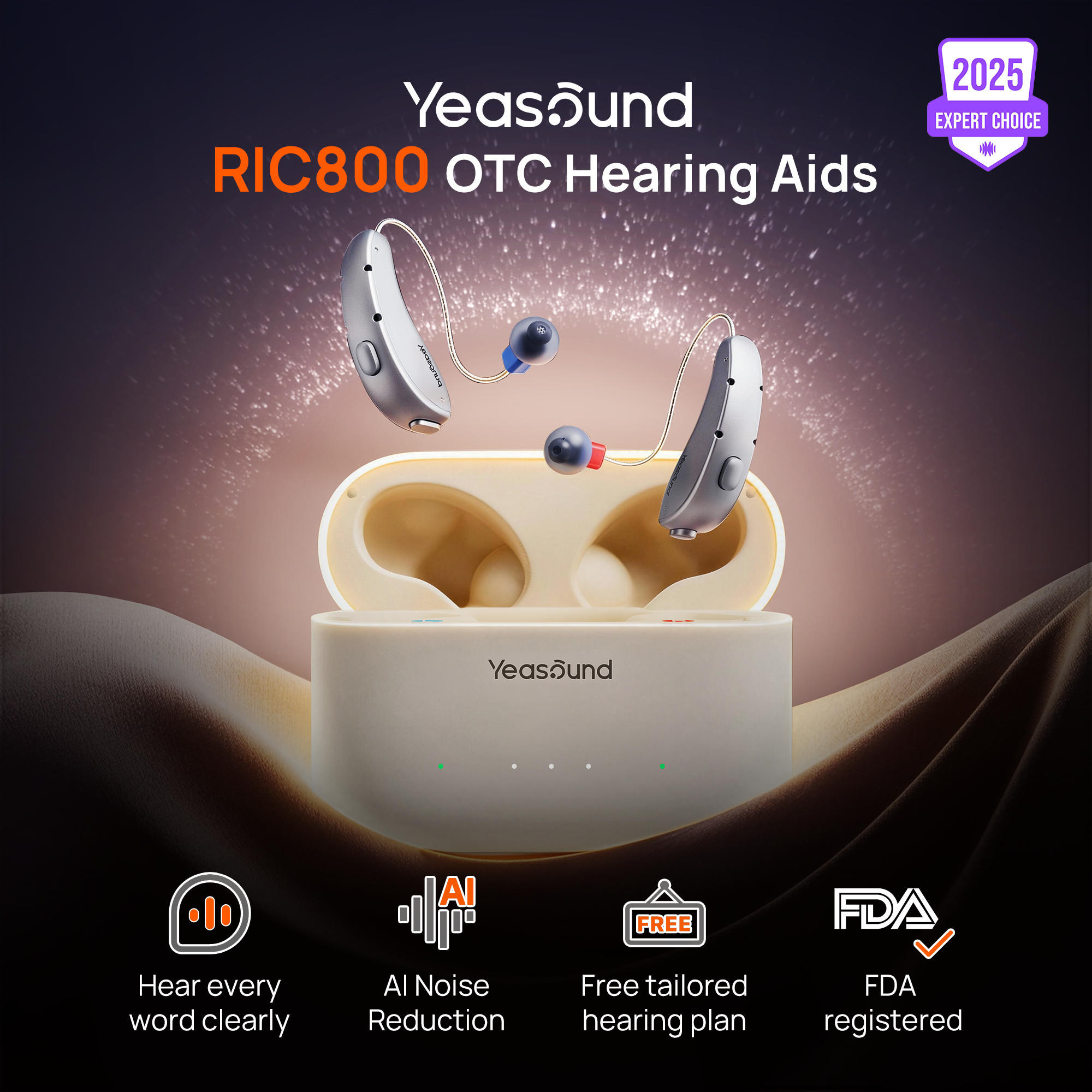
For adults in the mild-to-moderate sensorineural category, which covers most age-related hearing loss in the 45-70 range, FDA-registered OTC hearing aids like the Yeasound RIC800 are worth considering. The RIC800 is designed specifically for this profile: lightweight RIC design, AI-driven noise reduction, and a 100-day return window that lets you find out whether it addresses your specific hearing pattern before you decide. If you want setup details before choosing, the RIC800 guide explains quick start steps, manuals, compatibility help, and product resources.
FAQ
How many types of hearing loss are there?
The main types are sensorineural, conductive, mixed, and single-sided hearing loss. Auditory processing disorder is a related but distinct condition because the issue is sound processing rather than sound detection. In everyday hearing care, sensorineural and conductive hearing loss are usually the two categories people compare first.
What are the 4 types of hearing loss?
The four commonly discussed types are sensorineural, conductive, mixed, and single-sided hearing loss. Sensorineural loss involves the inner ear or auditory nerve. Conductive loss involves the outer or middle ear. Mixed loss combines both. Single-sided hearing loss affects one ear much more than the other.
What is the most common type of hearing loss in adults?
Sensorineural hearing loss, particularly age-related hearing loss, is the most common form in adults. It develops gradually, typically affects high frequencies first, and is permanent but often manageable with hearing aids or other hearing support.
Can I use an OTC hearing aid for any type of hearing loss?
No. OTC hearing aids are FDA-authorized specifically for adults 18 and older with perceived mild-to-moderate hearing loss. They are not the right first step for sudden hearing loss, severe or profound loss, single-sided deafness, or conductive hearing loss that may need medical treatment.
How do I know what type of hearing loss I have without seeing a doctor?
You can't know for certain without a diagnostic evaluation. Gradual difficulty in both ears, especially in noise or with high-pitched voices, may suggest age-related sensorineural loss. Sudden, recent, painful, or one-sided changes should be evaluated medically rather than treated as a self-fitting hearing aid problem.


Share:
Stay Updated
Get the latest hearing tips & news delivered to your inbox.