At some point in your 50s or 60s - sometimes earlier - you start noticing things. People seem to mumble more than they used to. Restaurants that never bothered you before now feel like work. You find yourself nodding along to things you only half heard, hoping the response did not give you away. If you are still unsure whether this is a pattern, a quick free online hearing test can give you a low-pressure first check.

Most people do not call this "hearing loss" right away. They call it tiredness, or bad acoustics, or other people not speaking clearly enough. And for a while, that explanation holds. Then it starts to feel less convincing. For a clearer symptom-by-symptom view, see Hearing Loss Symptoms: Normal Aging or a Sign You Should Act Now?.
Age-related hearing loss is one of the most common conditions in adults over 50, and one of the most delayed in being addressed. Understanding what it actually is, and what realistically helps, tends to make the decision clearer.
What Age-Related Hearing Loss Actually Is
The clinical term is presbycusis - gradual, bilateral sensorineural hearing loss caused by the natural aging of the inner ear's sensory hair cells. These cells convert sound into signals the brain can process. Over time, they deteriorate and do not regenerate.
According to the National Institute on Deafness and Other Communication Disorders (NIDCD), approximately one in three adults between 65 and 74 has some degree of hearing loss. By age 75 and over, that rises to nearly one in two.
It typically starts with the highest frequencies - the consonants S, F, SH, TH, and CH. These are the sounds that carry much of the meaning in English speech. When they become harder to distinguish, words start bleeding into each other. "Sixty" sounds like "fifty." "Ship" sounds like "chip." The voice is there; the clarity is not.
That is the defining feature of presbycusis: you can tell someone is speaking, but you cannot always tell what they are saying.
The Early Signs Most People Dismiss
Because age-related hearing loss develops slowly, often over years before it is noticeable, the early signs are easy to rationalize.
The noise filter disappears first. In a quiet room, one-on-one, most people with early presbycusis do reasonably well. Put them in a restaurant, a party, or a meeting with multiple speakers, and the difference becomes stark. For a deeper explanation of the noise problem, see why SNR matters for clear conversations.
High-pitched voices become harder to follow. Women's and children's voices sit in the frequency range most affected by presbycusis. If your partner's voice is easier to follow than your daughter's or a colleague's, that is a pattern worth noting.
Fatigue after social situations. The cognitive load of straining to follow conversations is exhausting. If you regularly feel drained after social events in a way you did not used to, listening effort may be a factor.
The TV volume gap. If your volume setting is consistently 5-10 notches higher than what other people in the room find comfortable, that is a functional signal, not a preference.
The Questions People Are Actually Afraid to Ask
Can age-related hearing loss be reversed?
Directly: no. The hair cell deterioration that causes presbycusis is permanent with current technology. Research into regenerative treatments is ongoing, but nothing is clinically available.
What this does not mean: that you are stuck with unchanged hearing indefinitely. Hearing aids work by amplifying and processing sound in ways that compensate for what the damaged hair cells can no longer do.
Will it keep getting worse?
Presbycusis is progressive. It tends to worsen gradually over time, not stabilize. The rate varies widely between individuals, influenced by genetics, cumulative noise exposure, cardiovascular health, and other factors.
This is an argument for addressing it earlier rather than later. The brain maintains its ability to process speech signals partly through regular use. Extended periods of reduced auditory input can make re-adaptation harder.
Does getting a hearing aid mean admitting defeat?
Using glasses does not mean admitting your vision has failed. Using hearing aids means choosing to remain in full contact with the people and conversations around you, rather than gradually withdrawing from them.
What Stage You're At - A Practical Self-Check
| What you're experiencing | Likely stage | Suggested path |
|---|---|---|
| Occasional difficulty in loud environments only | Very early / mild | Monitor; free online screener |
| Regularly struggling in noise; some TV volume complaints | Mild | OTC hearing aid trial reasonable |
| Difficulty in most group conversations; moderate TV adjustment | Moderate | OTC or audiologist evaluation |
| Struggling in quiet settings; frequently missing speech | Moderate-to-severe | Audiologist evaluation recommended |
| Significant difficulty in most situations | Severe | Audiologist required |
The distinction between mild and moderate matters practically: the FDA's OTC hearing aid category, authorized in 2022, applies specifically to adults with mild-to-moderate sensorineural hearing loss. That covers the largest share of people in the early-to-middle stages of presbycusis.
What Actually Helps
Hearing aids - the primary intervention
For mild-to-moderate age-related hearing loss, hearing aids are the evidence-based standard of care. They do not restore the hearing you had at 35; they amplify and process sound in ways that make speech clearer with the hearing you have now.
Modern hearing aids use digital signal processing, directional microphones, and AI-driven noise reduction to address the specific challenges presbycusis creates. Yeasound's OTC hearing aid sound technology page explains how these features support speech clarity, noise handling, and everyday listening.
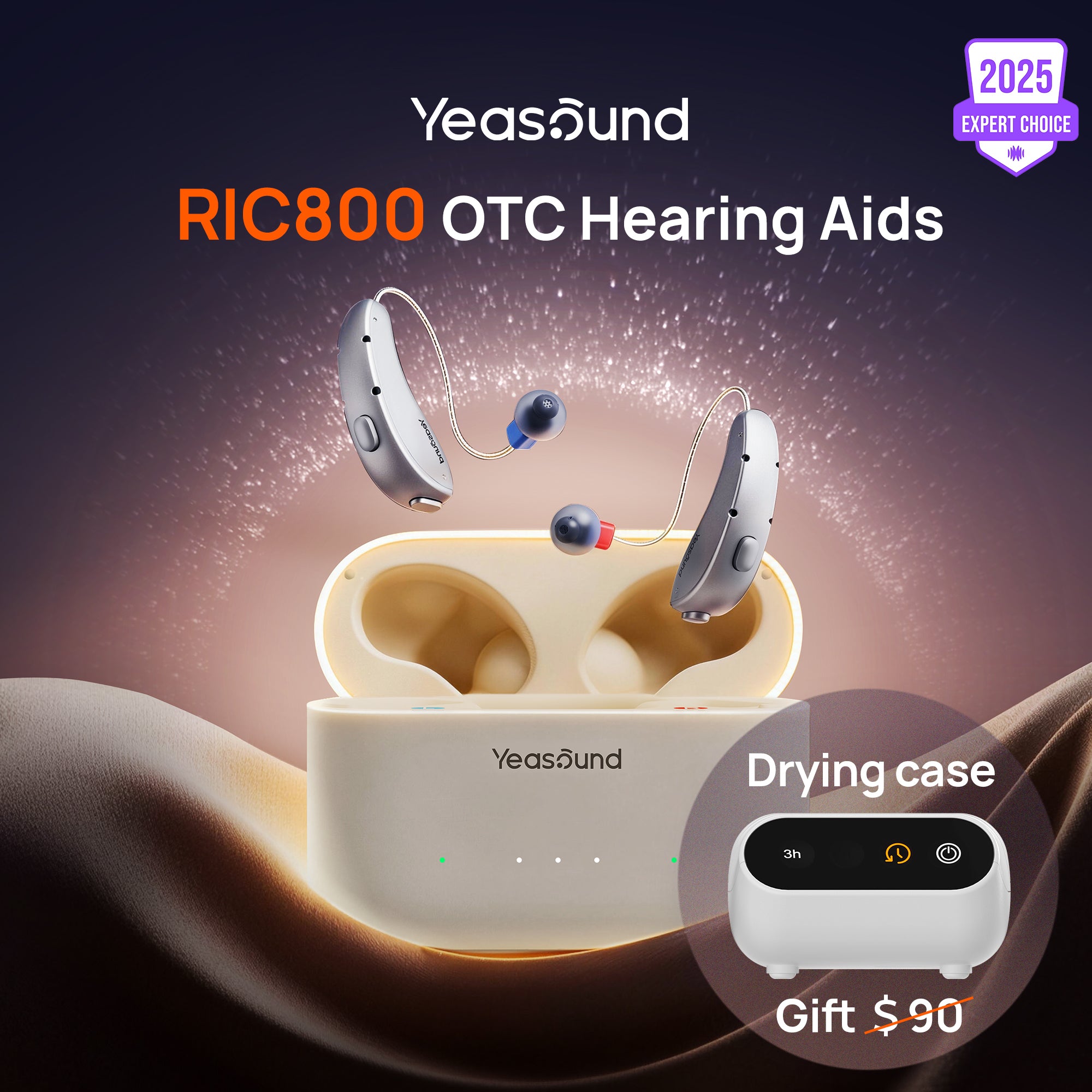
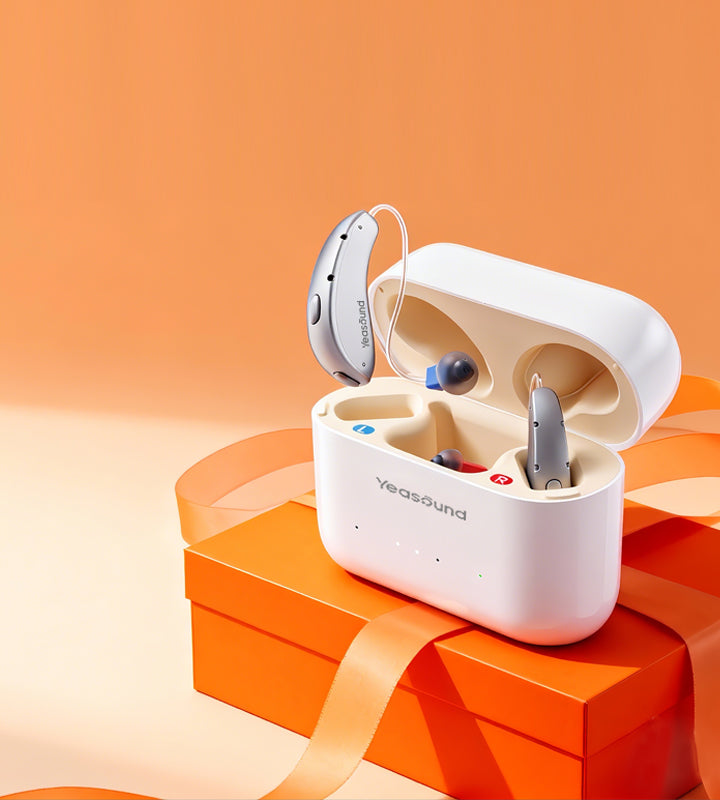
For adults who fit the mild-to-moderate OTC profile, the Yeasound RIC Series is a natural place to compare rechargeable RIC options. If noisy restaurants, TV, and group conversations are the main pain points, the RIC800 adds AI noise suppression, app adjustment, Bluetooth streaming, and a 100-day return window so you can test the fit in real life.
Audiologist evaluation
If you are uncertain about the degree of your loss, or if the OTC path does not produce satisfying results after a genuine trial period, a pure-tone audiogram gives you a precise picture of your hearing profile.
Communication strategies
While not a substitute for hearing aids, practical adjustments help: positioning yourself facing speakers, reducing background noise where possible, and telling people the clearest way to speak with you.
FAQ
What is age-related hearing loss called?
The clinical term is presbycusis. It refers to gradual, bilateral sensorineural hearing loss that occurs as the inner ear's sensory cells deteriorate with age.
When does age-related hearing loss usually start?
Most people begin experiencing measurable high-frequency changes in their 50s, though noticeable impact on daily communication often appears in the 60s or later.
Can age-related hearing loss be reversed?
No. The hair cell damage that causes presbycusis is permanent with current medical technology. Hearing aids can still compensate effectively for many daily communication needs.
Do I need a prescription to get hearing aids for age-related hearing loss?
Not necessarily. Adults with perceived mild-to-moderate hearing loss can consider OTC hearing aids. More complex, severe, sudden, or one-sided loss should start with professional evaluation.
Will wearing hearing aids make my hearing worse?
No. Hearing aids do not damage the residual hearing you have. In many cases, addressing hearing loss earlier makes adaptation easier.