




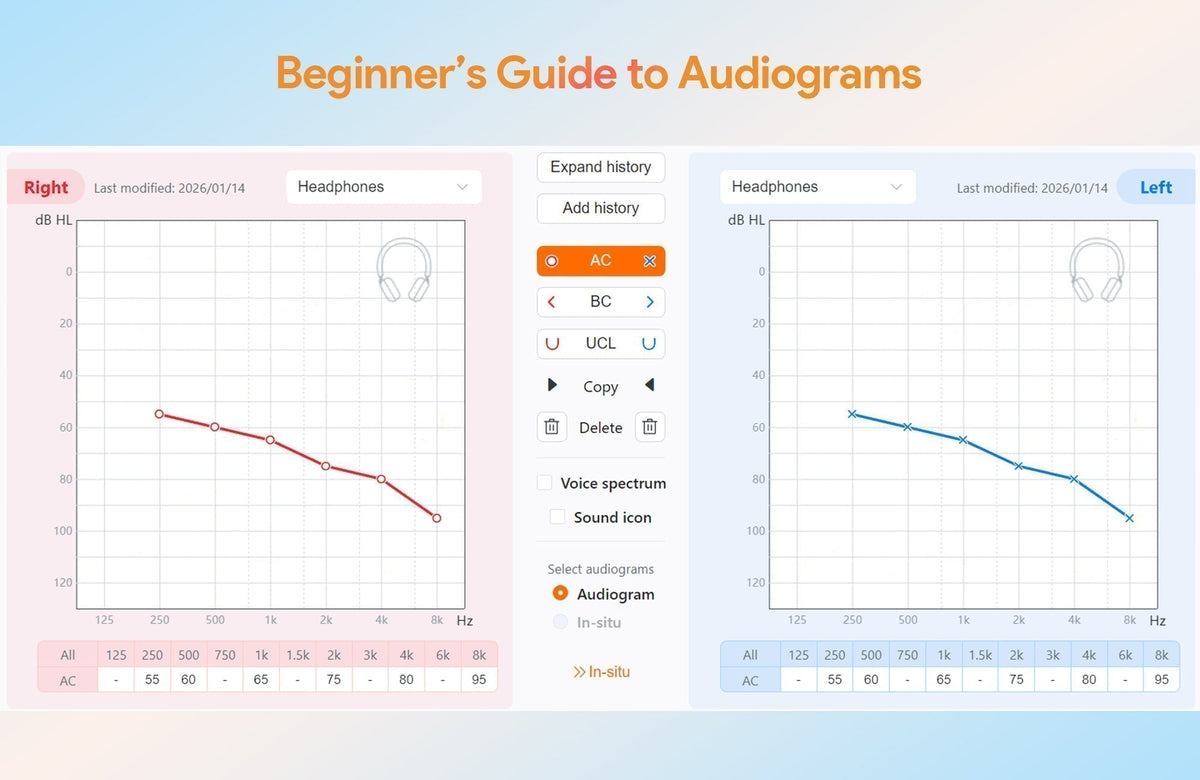
If you've ever taken a hearing test—whether on the Yeasound website or directly in the Yeasound app—you may have received a graph full of lines, symbols, and numbers called an audiogram.
At first glance, an audiogram can look confusing. But once you understand a few basics, it becomes much easier to read and understand what your results really mean.
If you haven't tried it yet, you can take a Yeasound hearing test online or in the iYeasound app first, then come back to this guide to learn how to read your results step by step.

What Is an Audiogram?
An audiogram is a chart that shows:
- How loud a sound needs to be for you to hear it
- At different pitches (frequencies)
- For each ear separately
In short, it is a visual picture of your hearing ability.
The X-Axis: Pitch (Frequency)
The horizontal axis (X-axis) shows frequency, measured in Hertz (Hz).
- Low pitches are on the left
- High pitches are on the right
Typical frequencies on an audiogram include:
- 250 Hz – very low-pitched sounds (like thunder)
- 500–1000 Hz – many vowel sounds (like a,o)
- 2000–4000 Hz – important speech clarity sounds (consonants like k, f)
- 6000–8000 Hz – very high-pitched sounds (birds chirping)
The Y-Axis: Loudness (Hearing Level)
The vertical axis (Y-axis) shows loudness, measured in decibels hearing level (dB HL).
This part is often confusing because:
- 0 dB does NOT mean "no sound", it means normal hearing level
On an audiogram:
- Top = softer sounds
- Bottom = louder sounds
Your hearing threshold on the chart shows the minimum loudness (in dB HL) required for you to hear a sound.
If your threshold appears lower on the chart, it means sounds must be louder before you can hear them, indicating poorer hearing sensitivity.
Left Ear vs. Right Ear: Understanding the Symbols
Audiograms use symbols to clearly separate the two ears.
Air Conduction (AC)
These test how you hear sounds through headphones.
Air conduction reflects the entire hearing pathway:
ear canal → eardrum → middle ear → inner ear → nerve
Degrees of Hearing Loss
Hearing loss is classified by how many decibels are needed for you to hear sounds.
| Degree | Hearing Level (dB HL) | What It Means |
|---|---|---|
| Normal | 0–25 dB | Can hear soft speech |
| Mild | 26–40 dB | Trouble hearing soft or distant speech |
| Moderate | 41–55 dB | Difficulty with normal conversation |
| Moderately Severe | 56–70 dB | Speech sounds muffled |
| Severe | 71–90 dB | Speech very hard to hear |
| Profound | 91+ dB | Only very loud sounds detectable |
Why Audiograms Matter
An audiogram helps you:
- Determine degree of hearing loss
- Decide whether hearing aids are needed
- Program hearing aids accurately
- Track hearing changes over time
👉 An audiogram shows hearing sensitivity, not listening ability in real life.
Real-world hearing also depends on noise, distance, and brain processing.
Reading an audiogram is easier than it looks. Once you understand the axes, symbols, and degrees of hearing loss, you'll be able to interpret your hearing test results with confidence. If you have any questions about your audiogram, Yeasound's hearing experts are always here to help.





Share:
Stay Updated
Get the latest hearing tips & news delivered to your inbox.