



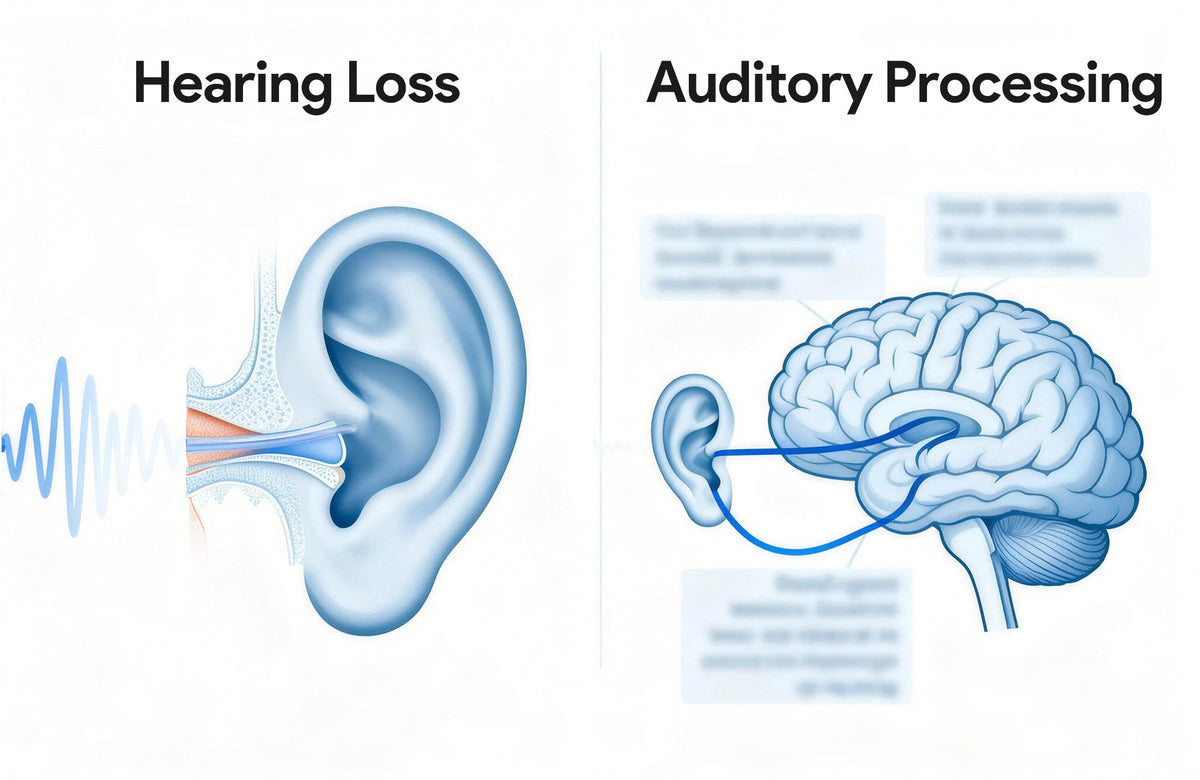
Hearing difficulties can present in different ways. It's common to assume that trouble following conversations or recognizing sounds is simply a matter of hearing loss, but that's not always the case. Hearing loss and auditory processing challenges are distinct conditions, and knowing the difference is key to finding the right support and solutions.

What Is Hearing Loss?
Hearing loss occurs when your ears are less able to detect sounds compared to normal levels. This can result from issues in the outer, middle, or inner ear, or sometimes due to problems with the auditory nerve.
Typical signs of hearing loss include:
Trouble understanding speech, particularly in noisy environments
Increasing the volume on TVs, radios, or other devices
Frequently asking people to repeat themselves
Ringing, buzzing, or other sounds in the ears (tinnitus)
Common causes:
Age-related changes (presbycusis)
Exposure to loud noises
Ear infections or fluid buildup
Genetic factors
Certain medications
If you're unsure about your hearing, you can take a quick online hearing screening on our Yeasound website to get an initial sense of your hearing health.
For people with measurable hearing deficits, hearing aids can help amplify sounds and improve clarity.
What Are Auditory Processing Issues?
Auditory processing disorder (APD) occur when the brain struggles to interpret the sounds that the ears detect. People with APD often have normal hearing thresholds, but their brain has difficulty making sense of what they hear.
Signs of auditory processing difficulties may include:
Struggling to understand speech in noisy or complex listening environments
Difficulty following multi-step verbal instructions
Confusing similar-sounding words
Trouble determining where sounds are coming from
Possible causes:
Brain injuries or stroke
Developmental conditions in children
Certain neurological disorders
In some cases, the cause may be unknown
Treatment typically involves auditory training, modifying listening environments, and the use of assistive devices. Hearing aids may also be part of the solution, but they are most effective when combined with additional strategies.
Comparing Hearing Loss and Auditory Processing Issues
|
Feature
|
Hearing Loss
|
Auditory Processing Challenges
|
|---|---|---|
|
Detection
|
Ears are less sensitive to sounds
|
Ears detect sounds normally
|
|
Primary Issue
|
Reduced volume or clarity of sounds
|
Brain has difficulty interpreting sounds
|
|
Typical Signs
|
Turning up volume, missing words
|
Trouble in noisy settings, mishearing similar words
|
|
Testing Methods
|
Standard audiogram
|
Specialized auditory processing assessments
|
|
Common Solutions
|
Hearing aids, amplification
|
Auditory exercises, listening strategies, assistive technology
|
Why the Distinction Matters
Confusing the two conditions can delay proper treatment. For instance, simply fitting a child with a hearing aid for auditory processing issues may not improve their comprehension. Similarly, someone with true hearing loss won't benefit from auditory training alone.
If you notice ongoing difficulty understanding speech or sounds, it's crucial to consult an audiologist. A professional evaluation can determine whether the challenge is due to hearing loss, auditory processing difficulties, or a combination of both.



Share:
Stay Updated
Get the latest hearing tips & news delivered to your inbox.