




You're at dinner with three people and you've lost the thread again. Not because you stopped paying attention — because the table next to yours is too loud, the background music is at exactly the wrong pitch, and someone keeps talking to the side of your face. You smile and hope your "mm-hmm" was appropriate.

Noisy environments are where hearing loss makes its presence felt most clearly. They are also where most people's frustration with hearing aids either begins or ends. A device that works well in a quiet room can feel useless the moment you walk into a restaurant.
If you are choosing a hearing aid specifically with noise in mind, or wondering why your current one does not help as much as expected, here is what actually matters.
Why Noise Is Harder Than Quiet - Even with Hearing Aids
Quiet environments forgive a lot. When you can see someone's face, hear them clearly, and there is nothing competing for attention, even modest amplification can seem like enough.
Noise is a different problem. The challenge is not just volume. It is separation. Your brain needs to identify one voice signal out of a field of competing sounds that are often similar in frequency and intensity.
A hearing aid that simply amplifies everything makes this worse, not better. You end up with a louder version of the same confusion.
The technology that actually helps works differently: it tries to do some of the separation work for you.
The Features That Actually Make a Difference in Noise

Not all noise-reduction features are equal. Here is what is worth understanding before you buy.
AI-Driven Noise Reduction
Basic noise reduction lowers volume in a certain frequency range. AI-driven noise reduction classifies incoming sounds in real time, distinguishes speech from non-speech, and reduces the non-speech components while preserving voice clarity.
Look for specific AI noise features, not just the phrase "noise reduction":
· Wind noise suppression - reduces the low-frequency rumble that masks speech outdoors
· Sudden noise suppression - prevents loud unexpected sounds from becoming jarring
· Auto speech focus - detects the direction of the voice you are listening to and deprioritizes competing voices
Directional Microphones
Most good hearing aids use at least two microphones. The processing system compares what each microphone picks up to determine where sound is coming from. For more detail, see Directionality in Hearing Aids Explained.
Multiple Environment Programs
A hearing aid optimized for quiet conversation is not optimally configured for a restaurant. Devices with General, Noisy, Outdoor, and Music programs allow you to switch to settings tuned for noisier environments.
What Real-World Noise Improvement Actually Looks Like
| Environment | What you typically experience with hearing loss | What well-designed noise processing can do |
|---|---|---|
| Restaurant | Voices blend into background; exhausting to track | Lifts speech-to-noise ratio |
| Work meeting | Miss contributions from across the table | Directional focus helps |
| Outdoor conversation | Wind masks speech | Wind suppression reduces the problem |
| Loud family gathering | Overwhelming; withdraw from conversation | Reduces overall load |
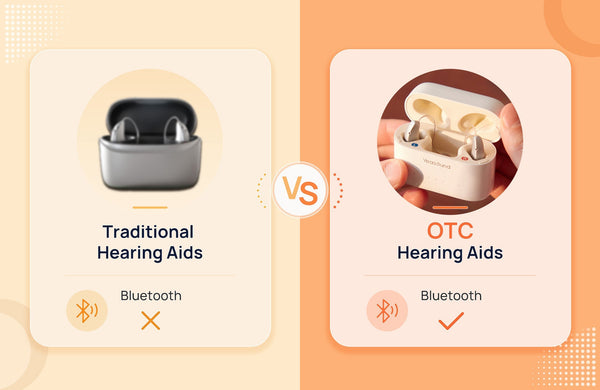
| Phone / TV with Bluetooth | No directionality issue | Streams directly to ears |
The honest framing: well-designed hearing aids do not make noisy environments easy. They make them manageable. The difference between "I can follow this conversation with effort" and "I have given up" is significant.
OTC vs. Prescription for Noisy Environments
This is where people most often wonder if they need to spend more.
The gap between OTC and prescription hearing aids in noisy environments used to be meaningful. That gap has narrowed since the FDA's 2022 OTC hearing aid ruling. Premium OTC devices now include the same classes of AI noise processing, directional microphone systems, and environment-specific programs as mid-range prescription aids.
Where prescription still has an edge: severe loss, unusual audiogram patterns, or loss that does not improve adequately after a genuine OTC trial period.
The practical test: if you are uncertain, buy an OTC device with a 45-100 day return window and use it specifically in your hardest noise environments.
What to Look for if Noise Is Your Primary Concern
Before buying, verify these specifically:
· AI noise reduction, not just "noise reduction"
· Directional microphones with at least 2 mics
· Noisy or restaurant-specific program
· Auto speech focus
· Trial period of 45-100 days
· Bluetooth streaming for phone calls and media
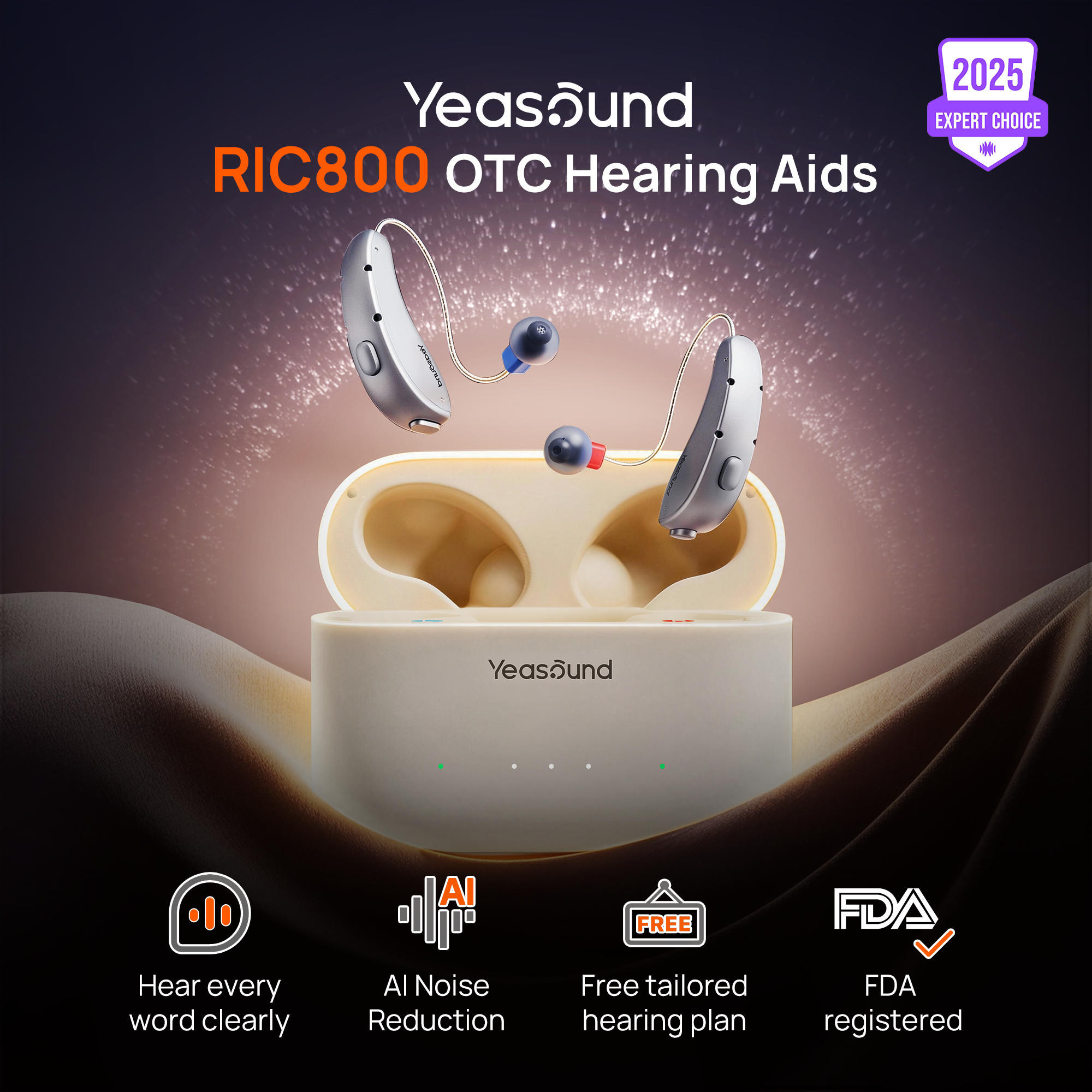
For age-related hearing loss with noise as the primary complaint, the Yeasound RIC800 is built around exactly this feature set: AI-driven noise suppression with wind and sudden noise reduction, auto speech focus, four environment programs, directional microphones, and Bluetooth streaming for both iOS and Android. At $629 with a 100-day return window, it lets you test the hardest situations instead of guessing from a product page. The RIC800 guide is useful if you want setup details before deciding.
FAQ
What makes some hearing aids better for noisy environments than others?
The key differentiator is the quality of the noise processing algorithm, especially whether it uses AI to distinguish speech from noise in real time and whether it includes directional microphone processing.
Why does my current hearing aid make noise worse, not better?
This usually means the device is amplifying all sounds proportionally, including the background noise you are trying to hear through.
Do I need a prescription hearing aid to hear well in restaurants?
Not necessarily. Premium OTC devices with AI noise processing can be a practical option for mild-to-moderate hearing loss in restaurant environments.
How long do I need to try a hearing aid before knowing if it works in noise?
At least 3-4 weeks of regular use in real noisy environments, according to the American Academy of Audiology. This is why a 45-100 day return window matters.
What's the difference between AI noise reduction and regular noise reduction?
Regular noise reduction applies a fixed filter. AI noise reduction classifies sounds in real time and adjusts continuously as the environment changes.


Share:
Stay Updated
Get the latest hearing tips & news delivered to your inbox.