



Our daily life is full of sounds — subways, restaurants, hairdryers, street dancing, construction sites, concerts…
But not all sounds are safe. Long-term exposure to loud noise can slowly damage your hearing — and most of the time, the damage is permanent.
But not all sounds are safe. Long-term exposure to loud noise can slowly damage your hearing — and most of the time, the damage is permanent.
So how many decibels (dB) are safe per day? How long before damage happens?

🧬 1. How Does Noise Actually Damage Your Hearing?
When sound enter your ear, they travel through the ear canal, hit the eardrum, and then pass into the inner ear (cochlea).
Inside the cochlea, there are thousands of tiny hair cells.
These hair cells bend back and forth with sound vibrations, and this movement converts sound into electrical signals that are sent to your brain.
These hair cells bend back and forth with sound vibrations, and this movement converts sound into electrical signals that are sent to your brain.
But when sound is too loud, the hair cells bend farther than they are designed to. Once a hair cell dies, it never grows back — humans cannot regenerate them.
This is why noise-induced hearing loss is permanent.
Over time:
Repeated loud sound → repeated over-bending → repeated injuries → permanent hearing loss
2. The Key to Hearing Damage:
How loud it is + how long it lasts
Hearing loss doesn’t always happen suddenly. It’s more like a cumulative energy injury.
To decide whether a sound is dangerous, you need to consider:
· Sound level (dB)
· Exposure duration
Think of it like sun exposure:
Stronger sunlight (higher dB) + longer time = higher risk of “sunburn” (hearing damage).
3. Safe Noise Exposure Standards
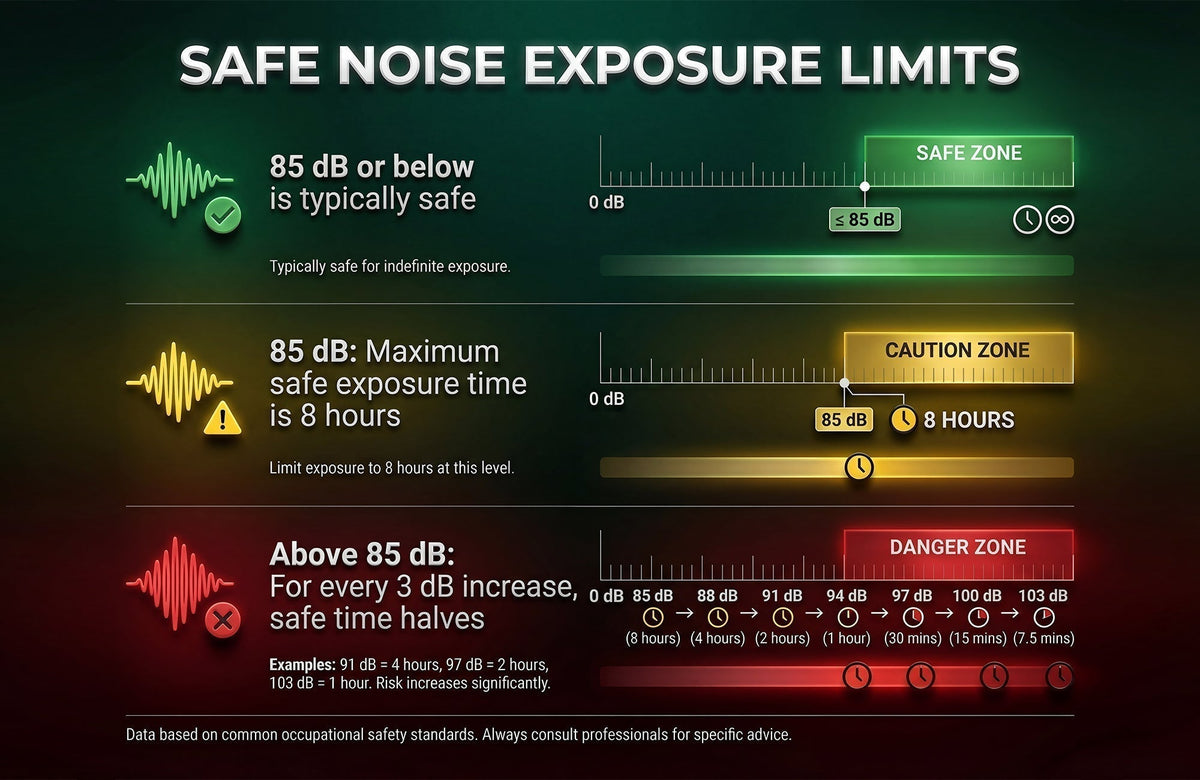
Different organizations vary slightly, but WHO, OSHA, and NIOSH have very similar recommendations:
✔ Below 85 dB → Generally safe
As long as exposure isn’t extremely long, it normally won’t cause permanent loss.
✔ 85 dB → Maximum 8 hours
Above 85 dB, every +3 dB cuts safe time in half.
Here’s the key table 👇
|
Example Environment
|
Volume (dB)
|
Safe Exposure Time
|
|---|---|---|
|
Normal conversation
|
60 dB
|
Safe
|
|
Vacuum / hair dryer
|
70 dB
|
Safe
|
|
Crowded restaurant
|
80 dB
|
~25 hours
|
|
Busy traffic / subway
|
85 dB
|
8 hours
|
|
Motorcycle / loud bar
|
95 dB
|
1 hour
|
|
Karaoke / large concert
|
100 dB
|
15 minutes
|
|
Nightclub / fireworks
|
110 dB
|
Less than 2 minutes
|
|
Firecracker or gunshot nearby
|
120–150 dB
|
Instant damage possible
|
🔥 4. How to Tell If Your Environment Is Dangerous
(Without using a sound level meter)
You can judge based on communication difficulty:
✔ If you must raise your voice → around 80–85 dB
✔ If you must shout to be heard → around 90–95 dB
✔ If you must shout to be heard → around 90–95 dB
You can also use a decibel App — not perfectly accurate, but helpful.
🛡️ 5. How to Protect Your Hearing in Loud Environments
✔ Carry earplugs
Think of earplugs as sunscreen for your ears — keep a pair with you just like you would carry lip balm or tissues.
Good earplugs can reduce sound by 15–25 dB and make concerts, bars, and subways much safer.
Good earplugs can reduce sound by 15–25 dB and make concerts, bars, and subways much safer.
✔ Turn the volume down
Reducing the volume by just 3 dB cuts the risk of hearing damage in half.
Small changes make a big difference.
Small changes make a big difference.
✔ Take quiet breaks
After loud exposure, your ears need recovery time.
Stepping outside a loud bar for 5–10 minutes helps your hair cells recover and reduces cumulative damage.
Stepping outside a loud bar for 5–10 minutes helps your hair cells recover and reduces cumulative damage.
✔ Know the early warning signs
If you experience:
· tinnitus (ringing),
· muffled hearing,
· difficulty understanding speech after noise exposure…
These are early signs of hearing damage.
❤️ 6. Summary — Just Remember These 3 Points
1. 85 dB is the safety threshold.
2. Above 100 dB (KTV/concert), damage may occur within 15 minutes.
3. The louder the sound, the shorter the safe time — every +3 dB cuts it in half.
Protecting your hearing today means protecting your quality of life for the next 20–30 years.


Share:
Stay Updated
Get the latest hearing tips & news delivered to your inbox.